

Cassava Leaves
vegetable
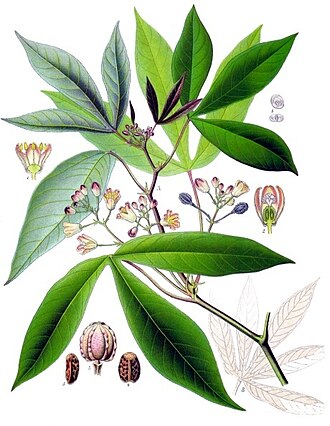
Manihot esculenta, commonly called cassava, manioc, or yuca, is a woody shrub of the spurge family, Euphorbiaceae, native to South America, from Brazil, Paraguay and parts of the Andes. Although a perennial plant, cassava is extensively cultivated in tropical and subtropical regions as an annual crop for its edible starchy tuberous root. Cassava is predominantly consumed in boiled form, but substantial quantities are processed to extract cassava starch, called tapioca, which is used for food, animal feed, and industrial purposes. The Brazilian farofa, and the related garri of West Africa, is an edible coarse flour obtained by grating cassava roots, pressing moisture off the obtained grated pulp, and finally drying and roasting it.
Conditions addressed
How to use
- Eat steamed, roasted, stir-fried, or raw in salads.
- Lightly cooking increases digestibility.
Pregnancy, Breastfeeding & Children
No herb-specific pregnancy/child safety research is documented for Cassava Leaves in our references — the guidance below is based on its general effect category, not research on Cassava Leaves itself. Always confirm with a midwife, doctor, or pediatrician.
Pregnancy
AvoidThis herb is associated with stimulant activity, which can raise heart rate and blood pressure — generally best avoided or strictly limited in pregnancy. This is a general, mechanism-based caution, not herb-specific research.
Breastfeeding
Use CautionStimulant compounds pass into breast milk and can cause infant irritability or poor sleep — generally used cautiously and in moderation.
Children
AvoidStimulant effects on the developing cardiovascular and nervous system mean these herbs are generally avoided in children.
Interactions & contraindications
May affect immune activity
Watch for: Immunosuppressants (for transplant or autoimmune conditions)
Immune-stimulating herbs can work against immunosuppressive therapy.
May have a stimulant effect
Watch for: Other caffeine-containing products, MAOIs, and stimulant medications (for ADHD or weight loss)
Additive stimulant effects can raise heart rate and blood pressure.